
Harrisonburg Projected Versus Actual Release
A projected release date is a forward-looking calculation based on the sentence, credited jail time, the credit system that applies, and the information then held by the responsible time-computation unit. An actual release date records the event after custody ends. These fields answer different questions. A future date should never be recast as proof that the person has left.
Pretrial detention works another way. A person held at Middle River Regional Jail or Rockingham-Harrisonburg Regional Jail before final judgment may leave after bond, recognizance, dismissal, acquittal, or another court order. There may be no fixed sentence-completion date. Posting bond also does not guarantee an immediate exit because processing or another detainer can keep custody in place.
A Harrisonburg case may move from a regional jail into VADOC custody without a community release. MRRJ holds some state-responsible prisoners awaiting transfer. In that setting, the local jail's end date marks a change of custodian, while VADOC continues the incarceration timeline. The receiving agency is an essential release-record field.
Find Harrisonburg Projected Release Dates
Start by classifying the custody. The VADOC Inmate and Supervisee Locator is meant for state custody and supervision, not every local booking. Its interface accepts the first three letters of the first name plus the full last name, or a seven-digit DOC ID. Advanced filters appear after acceptance of the disclaimer. VADOC says the data updates daily but may be inaccurate or outdated.
- Confirm whether the person is pretrial, locally sentenced, state responsible, federally sentenced, or held for another custodian. Use a booking or DOC number when possible.
- For a VADOC subject, search by DOC ID or the required name format. Record any date label exactly as shown and note the status and location.
- For a local sentence, contact the jail that applies the commitment. Ask for the calculated date and the releasable computation record rather than trying to apply a state formula.
- Read the sentencing order in the Harrisonburg/Rockingham court system. Separate active time from suspended time and note whether multiple terms run together or one after another.
- Check for a transfer, detainer, later sentence, amended order, or parole action. Confirm the final event with the agency that physically releases or transfers the person.
A no-result in VADOC does not prove release. A local-only misdemeanant may never enter that system, and a fully discharged state subject may not remain publicly searchable in the same way as an active inmate or supervisee. VADOC operating materials list an inactive-record request route when a current public result no longer answers the question.
The full Harrisonburg County release-record lookup can help identify whether the next step is the jail, the shared court, VADOC, VINE, BOP, or ICE.
Note: Match at least two identity fields before assigning a projected date to a person with a common or variant name.
Harrisonburg Release Date Computation
A reliable calculation begins with each signed sentencing order. The time-computation staff separate active confinement from suspended time, credit qualifying pretrial confinement under Virginia Code § 53.1-187, and identify whether sentences are concurrent or consecutive. Concurrent terms run at the same time. Consecutive terms run one after another. The offense date then determines which Virginia credit framework applies.
Credits can be earned or lost under the governing law. A detainer, new sentence, amended order, or clerical correction can also alter the operative date. Only the responsible jail or VADOC unit has the full set of official inputs. A member of the public should not subtract a flat percentage from the pronounced sentence and present the result as official.
The official VADOC time-computation material is shown in the successful project image below.
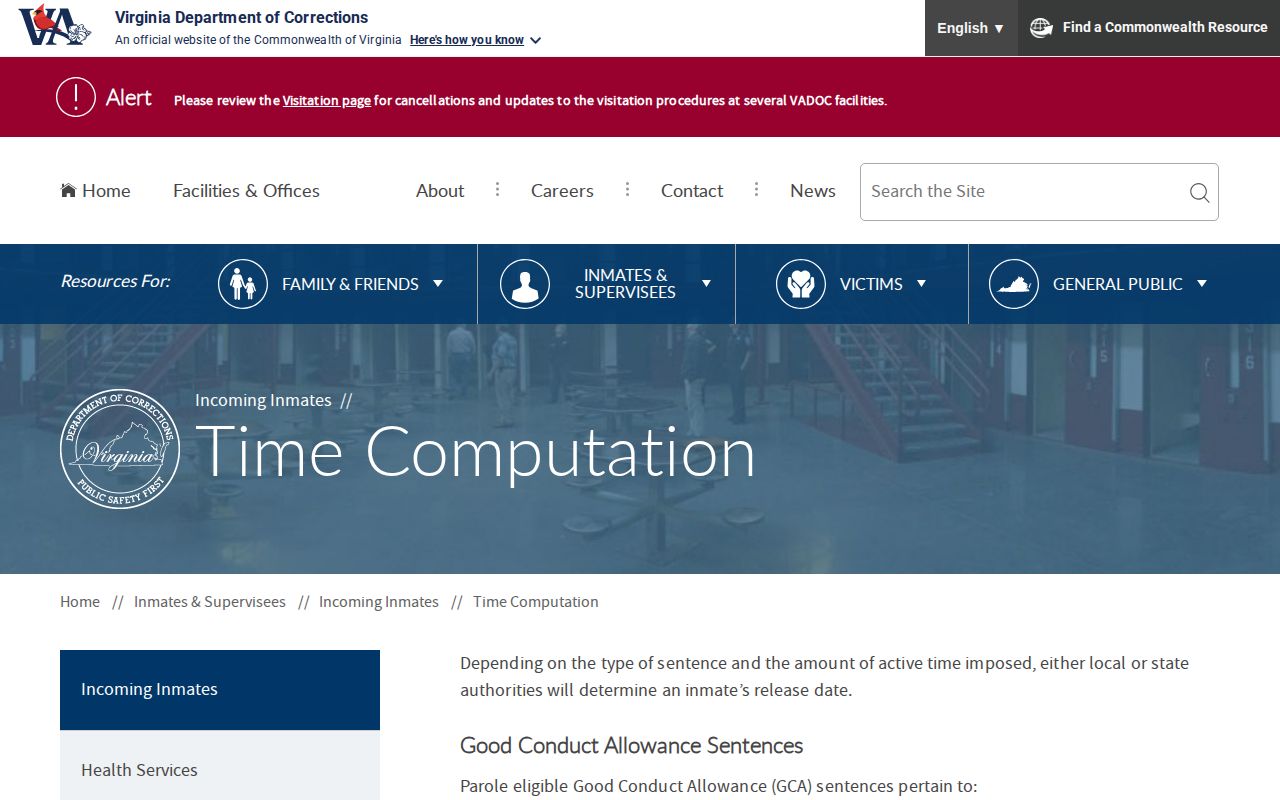
That source belongs to state sentence administration. MRRJ has no verified public Harrisonburg-specific calculator, so local jail dates should come from the jail's own calculation and the court commitments it applies.
Harrisonburg Earned Release Credits
Virginia's post-1995 framework uses earned sentence credits for covered felony sentences. Code § 53.1-202.2 defines an earned sentence credit as one day deducted from incarceration and sets statutory eligibility conditions after final conviction. Code § 53.1-202.3 ties the rate to offense category, classification, conduct, and participation in assigned work, education, or programs.
Classification can change. The law calls for review at least once each year, and disciplinary or noncompliance events can reduce the rate. Level IV earns no credit. Current law also treats listed offense groups differently, and future-effective text can change the analysis. The version in force for the relevant offense and calculation date must be used.
The official statute captured for the manifest is available at the Virginia legislative site.
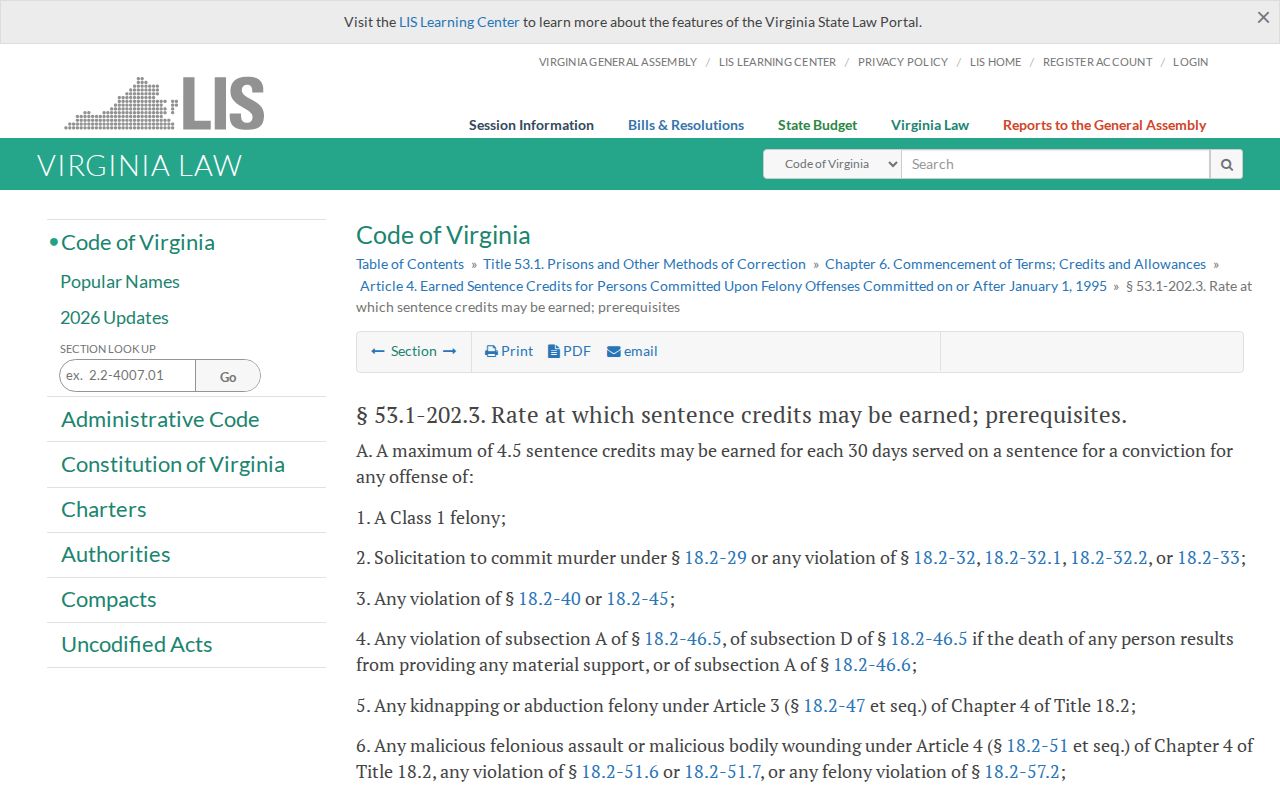
The statute shows why the rate cannot be reduced to one universal percentage. It also states that earned credits do not shorten the minimum period before parole eligibility on a parole-eligible sentence.
Older offense dates can fall under pre-1995 good-conduct and parole provisions in §§ 53.1-196 through 53.1-202. Those laws use different classes. Their effects may reach both the maximum term and parole timing, so the offense date matters more than a simple label such as old case.
Harrisonburg's 85 Percent Release Claim
The phrase serve 85 percent is shorthand, not a universal Virginia promise. Under the baseline maximum rate of 4.5 credits for each 30 days served, 30 physical days plus 4.5 credited days advance the sentence by 34.5 days. Simple division puts the physical service share near 86.96 percent, not exactly 85 percent.
That arithmetic is only an example. Offense exclusions, classification levels, lost credits, and other legal rules may require more time. Some people fall under older good-conduct law, while parole-eligible cohorts have separate timing rules. A flat 15 percent subtraction can therefore produce a false Harrisonburg County projected release date.
Use the actual statute and the responsible computation unit. Ask which credit system applies, the current classification, the certified jail credit, and whether the displayed date accounts for all active sentences. Do not ask staff to adopt a private calculation.
Why Harrisonburg Release Dates Change
A projected date is a snapshot. The legal and administrative inputs can change before release. Some changes move the date forward; others push it back or replace it with a transfer to a new custodian. The public display may also lag a correction made inside the agency's system.
| Factor | Possible effect | Best confirmation |
|---|---|---|
| Earned credits | Accrued credits can advance completion under the governing rate | VADOC or jail computation record |
| Credit loss or classification change | Can reduce future accrual or move the date later | Responsible computation unit |
| Pretrial jail credit | Certified qualifying time can reduce time left | Court order and certified jail record |
| Concurrent or consecutive terms | Changes whether sentences overlap or accumulate | Signed sentencing orders |
| Amended court order | May correct or replace an earlier sentencing input | Clerk-certified order |
| Detainer or new sentence | Can block community release or cause a transfer | Jail transaction and receiving custodian |
| Parole action | A grant can begin planning but does not set the physical exit alone | Board decision plus VADOC record |
A detainer is a request or hold from another authority. If ICE, another jail, or a state agency assumes custody, the first custodian may record an end event while confinement continues. The release record should name the receiving custodian whenever that field exists.
Note: An update delay changes what the public sees, but it does not change the legal release event in the originating record.
Harrisonburg Local Jail Release Dates
Middle River Regional Jail and Rockingham-Harrisonburg Regional Jail serve different parts of the local custody path. A person may be booked, held, transferred between facilities, or kept at MRRJ as state responsible while waiting for VADOC. Absence from one local view can therefore mean transfer, not release.
For a sentenced local case, ask the jail for the calculated release date and the releasable basis for it. Give the full name, date of birth or booking number, approximate booking date, and court case number. Request the active term, certified jail credit, applicable good-time entry, and any transfer or hold that affects the date. The MRRJ FOIA route can be used for an existing releasable computation record. No official public MRRJ calculator or Harrisonburg-specific good-time policy was verified.
Then read the Harrisonburg/Rockingham General District Court record or the individual Rockingham Circuit Court record, based on the case. The online docket is not the official court record. Obtain the signed order if sentence length, suspended time, or an amended term must be settled. Juvenile and sealed matters are not available through the public online path and should not be reconstructed.
Confirm Harrisonburg Actual Release Dates
VADOC's facility-release guidance says a state facility release occurs by 11:59 p.m. on the listed release date, weather permitting. That statewide rule does not automatically govern a bond release or local-sentence discharge from MRRJ. Local timing must come from the local facility. The signed Order of Release or notification-of-release letter can identify the state event after it occurs.
For local jail custody, Virginia Jail VINE can send a status-change notice after the reporting facility submits the event. A local release alert can also represent transfer into VADOC, so check the next custodian. For qualifying victims in state custody, VADOC's separate NAAVI system describes an advanced release notice as an anticipated date, often supplied about 30 days ahead, and sends another notice if that date changes.
Use the VINELink Check for a specific local-jail record and notification workflow. Preserve the exact event label and timestamp. Final confirmation should come from the jail or VADOC transaction, the signed court authority, and any receiving custodian when the movement was a transfer.
A fully discharged state subject may not remain visible in the public VADOC locator as an active inmate or supervisee. When the live result is no longer enough, VADOC operating materials identify Form 17 for inactive inmate or CCAP probationer and parolee records, along with Form 14 for consent to release information. A narrow request should seek the existing dates received, transferred, and released, the release type, and the receiving custodian. Medical, treatment, victim, and security material should be left out. That focused route helps separate an old projected date from the later event that actually ended or transferred VADOC custody.